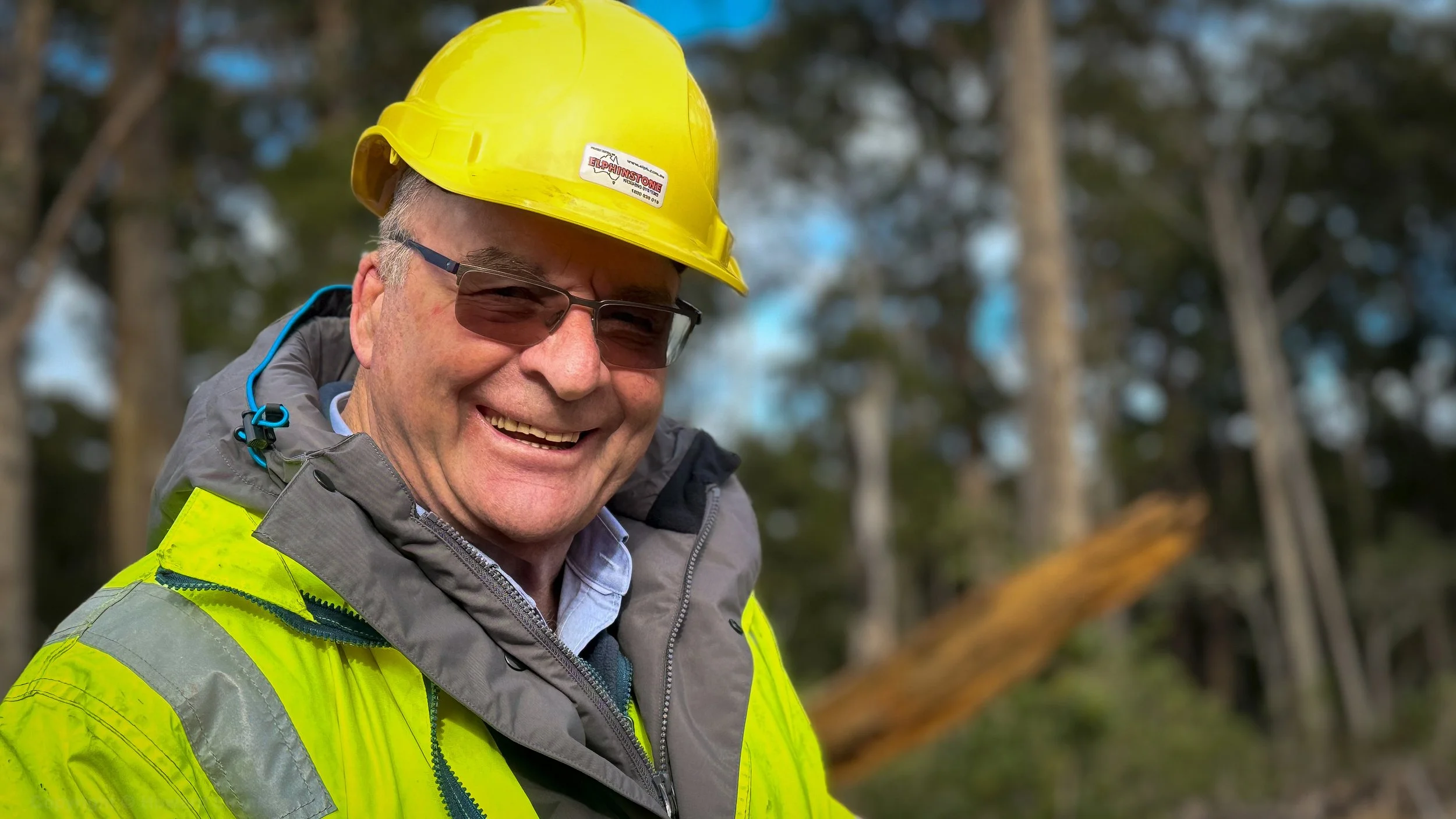
Graeme Elphinstone: Five Decades of Engineering Innovation in Australian Road Transport
Graeme Elphinsone - Back in 1976, when Graeme Elphinstone first fitted a set of imported scales to a log truck in Triabunna, Tasmania, little did he realise he was about to revolutionise the Australian transport industry. Over the next five decades, Graeme’s innovations would go on to shape trailer design, improve transport safety, and significantly enhance the efficiency of freight operations nationwide.
At a time when vehicle overloading was rampant and accurate weight estimation was almost impossible, Graeme’s onboard weighing systems introduced a new level of accountability. His work in effectively introducing on-vehicle weighing became the first Chain of Responsibility model in Australia. The Tasmanian Pulp & Forestry Holdings (Triabunna Chip Mill) adopted the model and supported the initiative with subsidies to log truck contractors. As he installed these systems, Graeme began studying trailer structures from the inside out, learning where failures occurred and how to engineer better solutions. The result was the Elphinstone tandem jinker and the start of a generation of trailers that were lighter, safer, more durable, and easier to maintain.
Graeme’s gift for practical problem-solving became even more apparent in the early 1980s. As tri-axle jinkers became common, many operators struggled with conventional six-spring suspensions unsuited to Tasmania’s rough forestry terrain. In response, Graeme developed the revolutionary Tri-Beam Suspension—a rugged, load-sharing system inspired by walking-beam designs. Its durability and simplicity in bush conditions earned Graeme national recognition, including the prestigious BHP Steel Award for Innovation.
During the economic recession of the 1980s, when rising interest rates and shrinking logging margins forced many operators to abandon equipment, Graeme again showed his ingenuity. He repurposed idle tandem jinkers into quad dog trailers, allowing contractors to form road trains and legally double their payload. This not only kept many businesses afloat but laid the foundation for a new era in timber haulage.
Throughout the 1990s and 2000s, Elphinstone Engineering released a series of pioneering transport solutions. From the EasyLoader Tri-Tri B-Double in 1997 to the world’s first self-loading road train in 2007 and the PBS-approved Long Logger in 2008, each design was underpinned by Graeme’s trademark blend of field-tested insight and mechanical simplicity.
Most recently, Graeme introduced the EasySteer trailer—a groundbreaking development in manoeuvrability, compliance, and payload capacity. Featuring a central articulation point and a unique axle group layout, the EasySteer allows for greater payloads, improved tracking, and superior swept-path performance in both urban and bush environments. This innovation not only improves the efficiency of freight operations but also sets a new standard for safety in the transport industry. Paired with Elphinstone’s precision onboard weighing systems, it represents the culmination of Graeme’s lifelong dedication to more innovative, safer transport solutions.
Yet Graeme’s legacy goes beyond trailers and technology. In his later years, he has dedicated a significant amount of his time to philanthropy in the forestry sector, supporting training programs, sustainable practices, and community safety initiatives. His contributions—both technical and cultural—reflect a deep-rooted commitment to resilience, resourcefulness, and the well-being of regional industries. His philanthropic work has not only improved the forestry sector but also inspired others to contribute to the well-being of their communities.
Graeme Elphinstone’s story is not just one of engineering brilliance; it is a testament to how practical innovation, born of real-world challenges, can drive an entire industry forward. Through every bracket, beam, and bolt, his work continues to shape the road ahead. His practical innovations have not only solved real-world problems but also set new standards in the transport industry, inspiring others to push the boundaries of what is possible.